
Alternative Solutions to Fluoropolymers in Hard Surface Sealers
Share


Abstract
Fluoropolymers are typically used as stain and water repellants to protect various hard surfaces. Fluoropolymers are able to create a very low surface energy on different surfaces, much lower than water and typical household stains including oils and acids. Fluoropolymers create barriers that are difficult to penetrate, creating a superb surface sealant. Due to increased regulations regarding fluoropolymers because they fall under the category of PFAs (forever chemical) it is imperative to find PFAs free solutions for various applications. This paper will discuss a waterborne alternative to fluoro polymers used in hard surface sealers for water and stain repellency.
Introduction
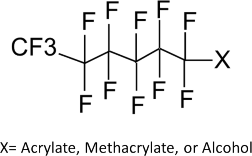
Fluoropolymers are used in many different applications because of their unique properties. Fluoropolymer emulsions and dispersions are used in stone care applications to seal and protect different stone surfaces from solvents, stains, oil, and water without changing the appearance of the stone. Fluoropolymers fall under the category of PFAs (forever chemicals) that have been linked to health hazards and persistence in the environment. The challenge with finding an alternative solution for this application is being able to find a coating that can protect the stone without changing the appearance. Fluoropolymers are unique because of the low surface energy that they can impart on different substrates due to the C-F bonds that are present in the polymers. Figure.1 shows the starting fluorinated monomer used in making fluoropolymers. PTFE and PVDF can have surface energies as low as 20 dynes/cm (1). When it comes to stone care the main fluorine- based chemistry that is used is a fluorophosphate esters, which provides the best resistance without changing the appearance of a stone.
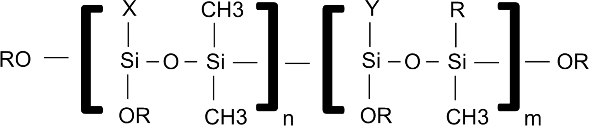
A material that can impart low surface energies is almost as low as fluoropolymers is silicone. Silicone elastomers can have surface energies as low as 23 dynes/cm (1). Figure. 2 shows the basic structure of a PDMS (Silicone). Silicones are also used for protecting stones from water penetration, but they do not protect against stains and oil as well as Fluoropolymers do. It is possible to modify the silicone backbone to make it more oil and stain repellant by incorporating longer alkyl groups and reactive groups for crosslinking. Figure. 3 shows an example of a modified silicone where the R groups could be methyl or
ethyl groups, the X is a long alkyl chain, and the Y is a hydrophilic group. In this work we will showcase how a modified silicone resin emulsion can provide similar water, oil, and stain repellency to a fluorophosphate ester.

Experimental and Testing
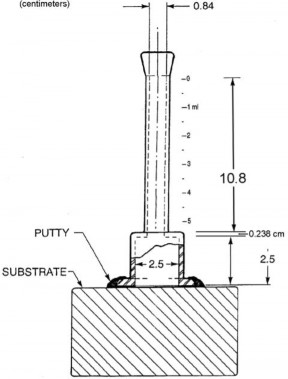
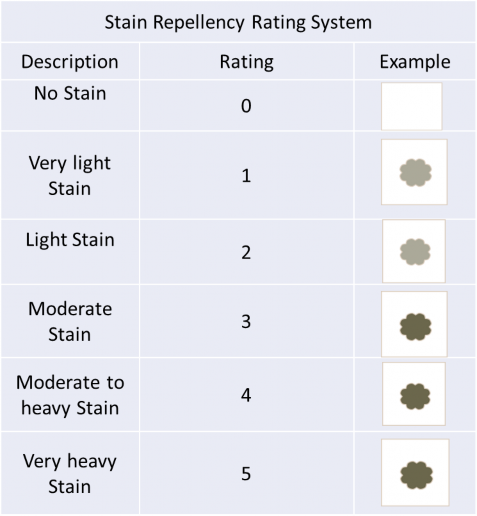
In this study a modified silicone emulsion (MSE) was evaluated in comparison to a C6 fluorophosphate ester (FPE). The modified silicone emulsion is 40% active emulsion. The silicone is composed of a PDMS backbone with reactive alkoxy groups, long chain alkyl groups, and amine groups. The fluorophosphate ester is a 13% active dispersion in water. The two chemistries were evaluated for water repellency and stain repellency. The water repellency of the products was determined by rilem test method 11.4 (2) on concrete slabs. The apparatus used for the rilem test method 11.4 is shown in Figure. 4. The water absorption into the substrate is recorded after 1, 2, 4, and 24 hours. The stain repellency of the products were evaluated via 24 hour stain testing on limestone, marble, and travertine. The stains and staining pattern is shown in Figure. 5. The stain rating scale is shown on Figure. 6. The stains were applied and allowed to sit on the surface for 24 hours before being cleaned off with water. Water and oil repellency were also evaluated by water and oil beading on the various substrates mentioned. The beading rating is shown on Figure. 7. In all of these studies the coatings are applied with a foam brush and allowed to cure for 24 hours before being tested.


Results and Discussions
In the first study water repellency and water hold out of the products was evaluated via Rilem Tube testing. The products were evaluated at 1%, 3% and 5% actives. The products were brush applied and allowed to cure for 16-24 hours before the rilem tube was anchored to the concrete with sealing putty. Table one showcases the results of the study. The results show that with the optimal loading level of the modified silicone emulsion, being 5% actives you can achieve the same level of water hold out as the fluorophosphate ester at a high loading level after 24 hours of water exposure.

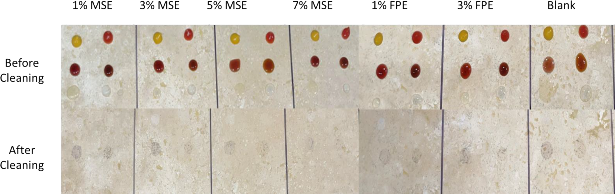
The stain repellency test was conducted with 1% and 3% active fluorophosphate ester and 1%, 3%, 5%, and 7% active modified silicone emulsion. The loading levels observed were the optimal loading levels based off a more extensive study. Using loading levels higher than 7% for the modified silicone emulsion or higher loading levels of the fluorophosphate ester higher than 3% does not improve performance. The products were brush applied and allowed to cure for 16-24 hours before the stains were applied. The substrates observed were limestone, travertine, and marble. The results show that the optimal loading level of the modified silicone emulsion is 7% actives to achieve similar stain repellency to the fluorinated product. Figures 8-10 show the staining results on marble, travertine, and limestone respectively. Tables 2-4 show the number rating for each stains on each of the substrates.


| Treatments | |||||||
| Stains | Blank | 1%MSE | 3%MSE | 5%MSE | 7%MSE | 1% FPE | 3% FPE |
| Ketchup | 0 | 1 | 1 | 0 | 0 | 0 | 0 |
| Mustard | 0 | 1 | 1 | 0 | 0 | 0 | 0 |
| Wine | 3 | 3 | 2 | 2 | 1 | 2 | 0 |
| Coffee | 4 | 3 | 2 | 2 | 1 | 0 | 1 |
| Oil | 3 | 1 | 1 | 0 | 0 | 0 | 0 |
| Water | 0 | 0 | 0 | 0 | 0 | 0 | 0 |
| Stain Ratings-Travertine | |||||||
| Treatments | |||||||
| Stains | Blank | 1%MSE | 3%MSE | 5%MSE | 7%MSE | 1% FPE | 3% FPE |
| Ketchup | 0 | 0 | 0 | 0 | 0 | 0 | 0 |
| Mustard | 0 | 0 | 0 | 0 | 0 | 0 | 0 |
| Wine | 3 | 3 | 3 | 1 | 1 | 2 | 1 |
| Coffee | 2 | 2 | 2 | 1 | 0 | 2 | 1 |
| Oil | 1 | 1 | 1 | 0 | 0 | 0 | 0 |
| Water | 0 | 0 | 0 | 0 | 0 | 0 | 0 |
| Stain Ratings-Limestone | |||||||
| Treatments | |||||||
| Stains | Blank | 1%MSE | 3%MSE | 5%MSE | 7%MSE | 1% FPE | 3% FPE |
| Ketchup | 1 | 0 | 0 | 0 | 0 | 0 | 0 |
| Mustard | 1 | 0 | 0 | 0 | 0 | 0 | 0 |
| Wine | 3 | 2 | 1 | 1 | 2 | 1 | 1 |
| Coffee | 3 | 1 | 1 | 1 | 1 | 1 | 1 |
| Oil | 3 | 1 | 1 | 1 | 0 | 0 | 0 |
| Water | 0 | 0 | 0 | 0 | 0 | 0 | 0 |
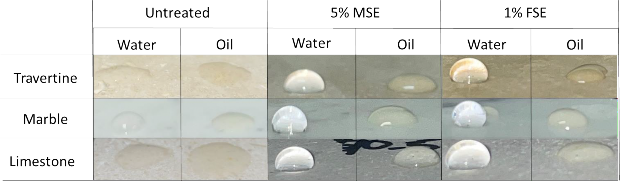
The water and oil beading testing was conducted with 5% active modified silicone emulsion and 1% active fluorophosphate ester. The loading levels chosen are the optimal loading levels for the best performance. Increasing the loading level did not significantly affect the performance. The coatings were brush applied and allowed to cure for 16-24 hours before the beading testing was conducted. The water and oil beads were allowed to sit on the substrate for 1 minute to allow the bead to stabilize before recording the results. The substrates that were observed were limestone, marble, and travertine. Results show that the beading effect that the modified silicone emulsion and the fluorophosphate ester are very similar. Figure 11 shows the water and oil beads on marble, travertine, and limestone respectively. Table 5 shows the number rating for the water and oil beading.
| Water and Oil Beading Ratings | ||||||
| Untreated | 5% MSE | 1% FSE | ||||
| Substrate | Water Rating | Oil Rating | Water Rating | Oil Rating | Water Rating | Oil Rating |
| Travertine | 0 | 0 | 3 | 2 | 4 | 2 |
| Marble | 1 | 0 | 4 | 2 | 4 | 2 |
| Limestone | 0 | 0 | 4 | 3 | 4 | 2 |
Conclusions
In this work it was demonstrated that fluoropolymers can be replaced with non-fluorinated solutions for stone care. It is shown that a modified silicone polymer can lower the surface energy substrates to provide water, oil, and stain repellency on various stones. In the first study it was found that the water hold out performance of a fluorophosphate ester at 3% active can be matched by using a 5% active loading of the modified silicone emulsion. In the second study it is shown that the stain repellency of a fluorophosphate ester can almost be matched with the use of a modified silicone emulsion. There is still more work that needs to be done in order to achieve the same wine and coffee resistance that the fluorophosphate ester provides. In the last study the water beading and oil beading was studied. The study showed that the modified silicone emulsion can lower the surface energy as low as the fluorophosphate ester can on various substrates. Based on the results of the study it is proven that a fluoropolymer can be offset by a non-fluorinated solution for stone care applications.
Citations
- Hild, F. (2020, December 15). Surface Energy of Plastics. Bearing Manufacturer. Retrieved December 13, 2021, from https://www.tstar.com/blog/bid/33845/surface- energy-of-plastics.
- Measurement of water absorption under low pressure RILEM Test Method. Prosoco. (2021, June 21). Retrieved December 13, 2021, from https://prosoco.com/measurement-of-water-absorption/.